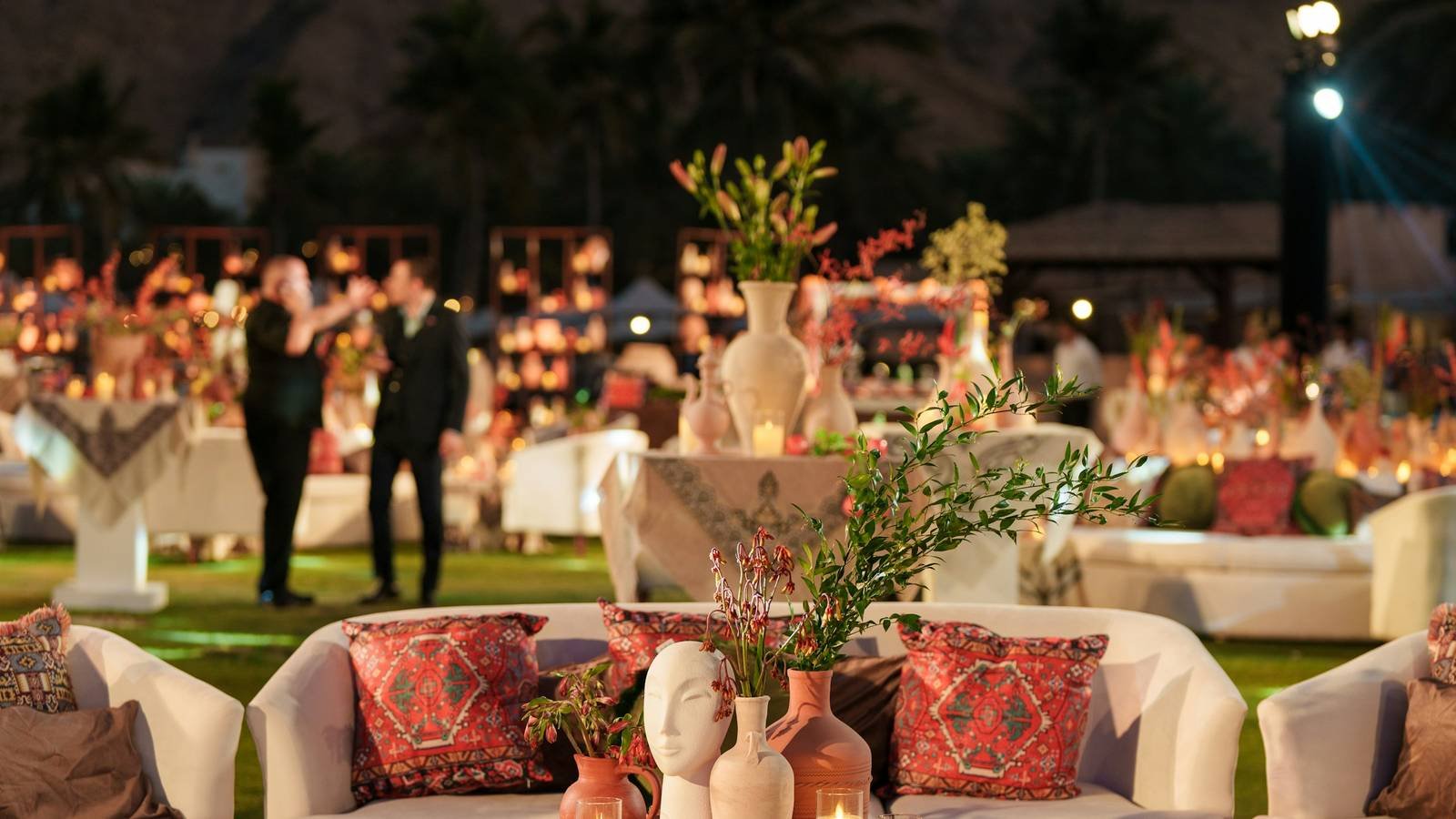
The measure of a well-produced event is what the guests never notice. They never see the third catering runner who was held in reserve, the alternate route the cars took when a road closed, the entertainer who was quietly moved forward twenty minutes because the dinner ran long, or the person near the entrance whose whole evening was spent making sure nothing happened. What guests remember instead is that the night felt effortless - that they arrived, were received, ate well, were moved through the evening without ever being managed, and left with the sense that everything had simply fallen into place. It never falls into place. It is placed, carefully, by people who then spend the night making sure their own work stays invisible. That is what we mean by an event done quietly.
What "done quietly" actually means
There is a version of event production that is loud on purpose - where the machinery is the show, and the host wants everyone to know how much has been spent. That is a legitimate choice, and it is not the one most of our members make. The people we work with tend to want the opposite: an evening that feels generous and considered without ever announcing its own budget, where the luxury is in the ease of it rather than the spectacle. Done quietly does not mean modest. It means that the effort is felt and never seen - that a guest senses they are being looked after beautifully without being able to point to the mechanism doing it.
Achieving that is harder than a visible production, not easier. When the machinery is meant to show, a seam here or there is forgiven as part of the spectacle. When the entire brief is invisibility, every seam is a failure. The bar is not "impressive." The bar is "seamless," and seamless is a discipline.
One point of contact, many moving parts
The single most important decision a host makes about an event is not the venue or the menu - it is whether one team owns the whole thing or whether the host is left stitching together a florist, a caterer, a production company, a transport firm and an entertainer who have never worked together and answer only for their own piece. When those pieces are separately booked, the host becomes the integration layer by default. Every gap between vendors becomes the host's problem, usually at the worst possible moment.
We take that integration off the host entirely. One point of contact holds the venue relationship, the catering brief, the production design, the entertainment schedule, the transport and arrivals plan, and the timeline that binds them together. When the dinner runs fifteen minutes long, one person adjusts the entertainment, tells the transport team, and resets the rest of the evening - without the host ever knowing there was a decision to make. This is the same coordination discipline that underpins how we orchestrate a destination wedding as one weekend rather than a stack of separate bookings: the value is not in any single vendor, but in the fact that they are all answering to one plan.
The design decisions that guests feel but never see
Most of what makes an event feel effortless is decided long before anyone arrives. Where guests are received, and how, sets the tone for the entire night - a crowded, uncertain arrival is difficult to recover from, while a calm, warm reception buys goodwill that carries through dinner. The flow of the space determines whether people mix or cluster. The pacing of food, drink and entertainment decides whether the evening feels rushed, dragging or exactly right. The lighting, quietly, does more emotional work than almost anything else in the room.
Production, at the high end, is where a great deal of the budget lives, and it should be. Independent industry figures for 2026 place broadcast-quality staging, LED and lighting design anywhere from $50,000 into the mid-six figures for elaborate custom builds, with per-person costs for the most lavish gala-level evenings climbing above $1,000 a head once premium catering, entertainment and design are accounted for (EMRG Media). Those numbers are worth knowing not because every event needs them, but because they show where the real money goes: not into the visible glamour, but into the infrastructure that makes the glamour possible and reliable.
Brand events: the same craft, with a reputation attached
A brand event runs on exactly the same coordination discipline as a private one, with one difference that changes everything: it exists to make an impression on an invited public, and it carries the host's reputation into the room. A private dinner that runs slightly late is a minor thing among friends. A brand launch that runs slightly wrong is documented, discussed and remembered. The stakes of the seams are higher because the audience is watching with intent, and often with cameras.
That raises the standard on two things in particular. The first is the guest experience at the edges - arrivals, departures, waiting, the small frictions that a friendly private crowd forgives and an invited public does not. The second is control of the message and the image: who is in the room, what is photographed, what is said, and how the evening will read afterward. Producing a brand event well means protecting that reputation as carefully as the logistics - which is one of the quieter reasons discretion and coordination sit so close together in this work.
Security that reads as hospitality
For many private and brand events, a protective layer is part of the plan - and for almost all of them, the brief is that it must not feel like one. Guests should experience warmth and ease, not a cordon. Achieving that is a matter of planning, not muscle: an advance look at the venue, quiet coordination with the house and catering staff, sensible control of who comes and goes, and operatives who are briefed to read as part of the evening rather than a barrier around it. When it is done properly, the people keeping an event safe look like people helping it run.
This is deliberately a supporting detail, never the headline. Coordinated protection days, where they are needed, start from €1,800 and are shaped entirely around the specific evening - but the point of building them in early is precisely so that no guest ever registers them. The measure of success is that the security worked and nobody noticed it was there. Where an event calls for it, our executive concierge and protective teams plan that layer together from the first conversation, so it is woven into the night rather than stitched on at the door.
What we hold ourselves to
We do not hand a host a generic package and hope the room fills it. We plan every event around the specific people in it - who is coming, what the evening is meant to achieve, how it should feel to walk in and how it should feel to leave. We price each element transparently and show the host a single, final rate, never an inflated bundle with the reasoning hidden. And we hold ourselves to the standard that matters most for this kind of work: that on the night, the host attends their own event as a guest, and the only evidence of everything behind it is that nothing ever went wrong.
If you are planning an evening that should feel effortless to every person in the room - and reveal none of the work behind it - we would be glad to help. Visit algozgroup.com or explore our executive concierge service to start the conversation.
Frequently Asked Questions
What does producing a private event actually involve beyond a party planner?
A single point of coordination across every moving part - venue, catering, entertainment, production, transport, arrivals and, where a guest's profile calls for it, a discreet security layer - so the host attends their own event as a guest rather than running it. The planning happens weeks ahead; on the night, the work is invisible.
How much does a high-end private event cost to produce?
It depends almost entirely on guest count, venue and the level of production. Industry figures for 2026 put boutique private productions from around $15,000, per-person costs for elaborate gala-level evenings above $1,000 a head, and full custom production - LED, staging, lighting - from $50,000 into six figures. We price each element transparently and show the host the final rate, never a generic package.
What is the difference between a brand event and a private event for you?
The disciplines are the same; the audience and the objective differ. A private event exists for the host and their guests; a brand event exists to make an impression on an invited public. Both succeed on the same thing - flawless, invisible coordination - but a brand event carries an added layer of message, image and reputation that has to be protected as carefully as the logistics.
Can you handle security for an event without it being visible?
Yes - and for most private events that is the entire point. Discreet protection is planned into the event from the start, not bolted on at the door: advance work on the venue, quiet coordination with staff, and operatives who read as part of the evening rather than a cordon around it. Guests should feel at ease, never watched.
Planning a Private or Brand Event?
Algoz produces the evening quietly - one point of contact, every moving part handled, and nothing that shows on the night.
Request a Confidential Consultation