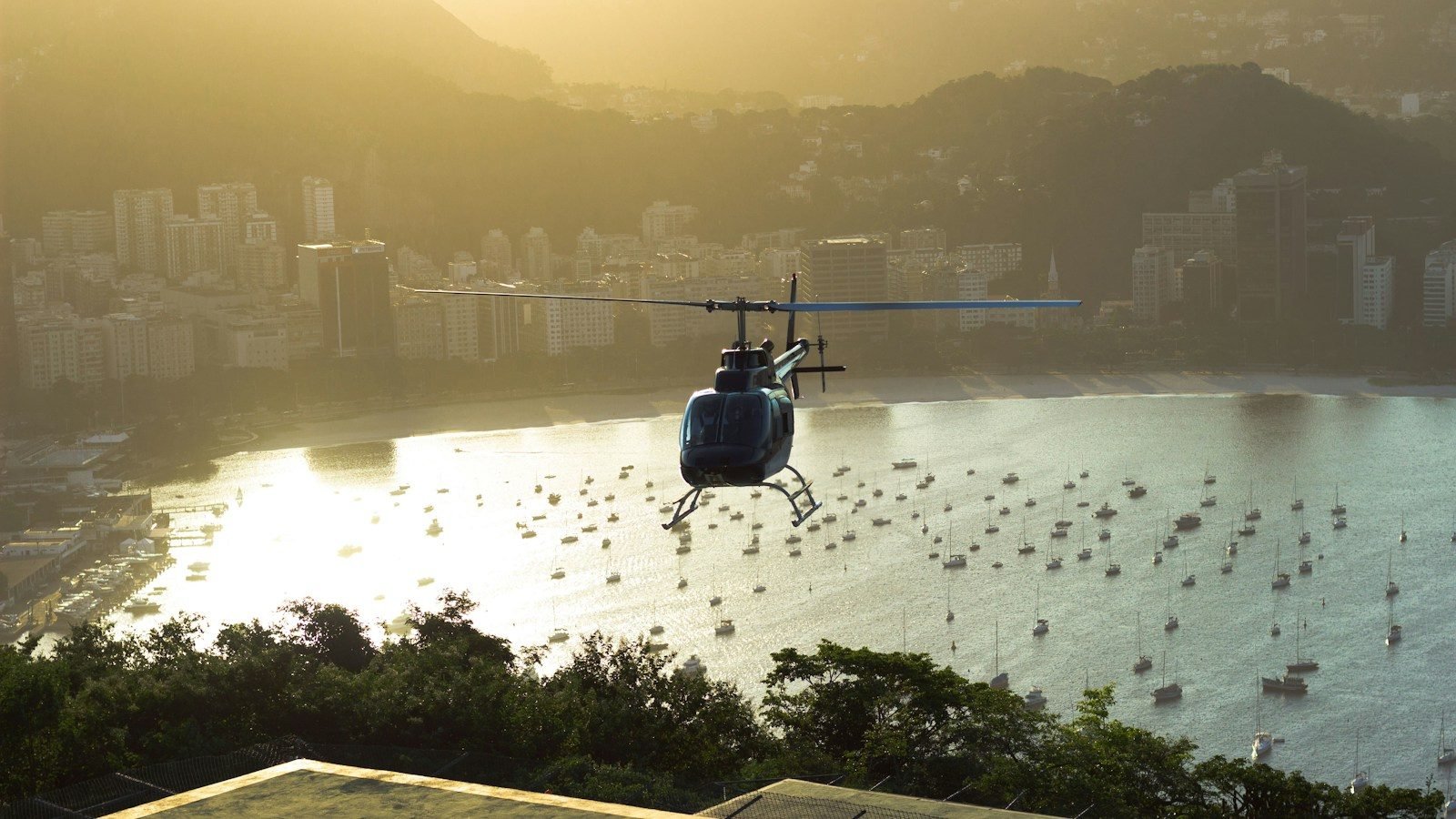
Helicopter transfers close the slowest part of a private journey, the stretch between an airport, a yacht, a resort and the final door, by replacing a congested coastal road or a snowbound mountain pass with a flight of minutes. Arranged well, a helicopter transfer is timed to the real landing of the jet, backed by a car in case the weather closes the route, and met at the far end by transport already waiting. Algoz FZ-LLC arranges helicopter transfers as part of the wider day, while licensed aviation operators fly the aircraft.
A private helicopter transfer is a short point-to-point flight that connects two fixed places a road cannot connect quickly. That is all it is. We do not sell the flight. We arrange the day around it, so the fifteen or thirty minutes in the air protect the hours that matter on either side.
When do helicopter transfers make sense?
Most private travel bottlenecks are not in the air. They sit at the seams: the stretch between a private terminal and the destination, where a jet's time advantage quietly disappears in traffic, ferry queues or switchback roads. A helicopter transfer exists to close exactly that seam, and it matters most in three recurring situations.
Jet to yacht. A principal lands at a coastal airport with a vessel waiting down the coast or across open water. By road, that means a marina car park, a tender crossing and an unpredictable drive. By air, it is a short hop to a marina heliport or, where the vessel is equipped, to its own helideck. Many superyachts carry a certified helideck or a touch-and-go pad, which puts the guest within a gangway of where they are actually staying.
The Riviera summer road. Between June and September the coastal roads linking Nice, Cannes, Antibes, Saint-Tropez and Monaco carry some of the heaviest seasonal traffic in Europe, and event weeks such as the Cannes Film Festival, the Monaco Grand Prix and the Monaco Yacht Show make it worse. The Nice to Monaco helicopter crossing takes around seven minutes in the air, against the better part of an hour on the coast road in August. Our executive transportation on the French Riviera is planned with that crossing in mind, so the car and the aircraft work as one plan.
The Alpine winter last mile. Ski resorts present geography rather than congestion. Mountain roads that are simple in September become slow, and occasionally closed, once the snow arrives. Courchevel's altiport sits at around 2,000 metres with a runway gradient of roughly 18.5 percent: aircraft land uphill and take off downhill, and only pilots holding a specific mountain qualification may operate there. From a gateway such as Geneva, a drive of two and a half to three hours in winter becomes a flight of well under an hour, landing inside the resort rather than at its edge.
Why does a helicopter transfer change the shape of a day?
None of this is about spectacle. It is about protecting the two or three hours that actually matter, a dinner reservation, a meeting, a child's early evening, from the one unpredictable variable between the airport and the destination. A helicopter transfer costs minutes where the road costs hours, and that difference is felt most on the days when everything else has been planned to the minute.
How is a helicopter transfer timed against a private jet arrival?
A transfer rarely stands alone. It sits between a jet's actual landing time, not its scheduled one, an onward car and whatever is waiting at the far end. We build around the realistic arrival window and hold a buffer for formalities, baggage, or a jet that lands early. Scheduled shuttles such as the Nice to Monaco service run regular departures through the day, which suits routine movement. For anything tied to a specific arrival, a chartered slot timed to the moment the guest is ready to fly removes the guesswork.
What happens to a helicopter transfer when the weather turns?
Helicopters are more exposed to weather than fixed-wing aircraft. Low cloud, strong wind or poor visibility can close a route at short notice, and mountain airfields are known for weather that changes quickly. We treat this as a planning input, not an afterthought. Every helicopter transfer we arrange carries a fallback from the start: a later window on the same route, or a car and driver on standby who can move within minutes. A weather delay then becomes a small adjustment to the day rather than a problem discovered at the helipad.
Which heliports and landing sites need special clearance?
Every heliport has its own character. The helipad beside Nice Côte d'Azur airport is built for volume, with lounges on either side of a short hop to the Fontvieille heliport in Monaco. Courchevel's altiport works on a restricted, seasonal basis that only certified crews may use. A yacht helideck needs its own coordination with the captain and the operator. Securing a slot at the right time, with an operator and aircraft cleared for that particular site, is a large part of what arranging a helicopter transfer means. For winter arrivals, our executive transportation in Courchevel meets the aircraft at the altiport or the resort heliport, so nobody waits in the cold.
How much luggage can go on a helicopter transfer?
Helicopters fly with real limits on weight and space, often closer to a generous cabin allowance than a full set of matched luggage. We plan the split before the day: what travels with the guest, what follows by road, and where it needs to be when they arrive. Ski equipment, long garment bags and hard cases are the usual surprises, so we ask about them early rather than at the aircraft door.
What should be waiting when the helicopter lands?
A helicopter transfer that ends with someone standing on a helipad waiting for a car has solved only half the problem. The point is a continuous chain: jet, helicopter, car, door, with no link left to chance. In Monaco, where the heliport sits at the western edge of the Principality, our executive transportation in Monaco has the vehicle at Fontvieille before the aircraft touches down, with the luggage that travelled by road already on its way to the hotel or the berth.
The payoff: arriving unhurried
Strip away the logistics and a well-arranged helicopter transfer buys a feeling rather than a fact: the sense of having skipped the part of the day that usually costs the most patience. It is the difference between landing into traffic with a dinner reservation in mind, and landing to find the short flight arranged, the car exactly where it should be and the evening still intact. Whether it is a jet to yacht handover on a July afternoon on the Riviera, a hop between Mediterranean islands, or the final stretch into an Alpine resort in January, the helicopter is rarely the memorable part of the day. Its job is to be forgettable.
That is the standard we hold the coordination to: not the flight itself, but everything around it working quietly enough that nobody has to think about it at all.
To arrange a helicopter transfer as part of your next journey, speak to your Algoz agent.
Excellence, Discreetly Delivered.
Frequently Asked Questions
How far in advance should a helicopter transfer be booked?
On a well-served route outside peak weeks, a few days is often enough. When the transfer is tied to a jet arrival, a yacht rendezvous or a high-season window, such as the Riviera in July and August or the Alps over Christmas, book as early as the rest of the trip, because slots and landing clearances fill first.
What happens to a helicopter transfer if the weather is bad?
Helicopters are more sensitive to low cloud, wind and visibility than private jets, so every transfer Algoz arranges has a fallback set before the day: a later flight window on the same route, or a car and driver on standby who can leave within minutes. The guest is moved either way, and the rest of the day keeps its shape.
Can a helicopter land on a yacht?
Yes, when the yacht has a certified helideck or a touch-and-go pad and the captain and operator have cleared the landing. Where a vessel is not equipped, the helicopter lands at the nearest marina heliport and a tender completes the transfer, which usually takes minutes rather than the hour or more the coast road would need.
Does Algoz operate the helicopters itself?
No. Algoz arranges the transfer as part of the wider journey: choosing the aircraft and operator, timing the slot against the jet arrival, handling clearances, luggage and the car at each end. Licensed aviation operators fly and maintain the aircraft, so the guest deals with one point of contact while certified crews handle the flying itself.
The Short Flight, Arranged Around Your Day
Aircraft, slot, weather fallback, luggage and the car at the helipad, held by one team from the jet door to your own.
Arrange a Transfer