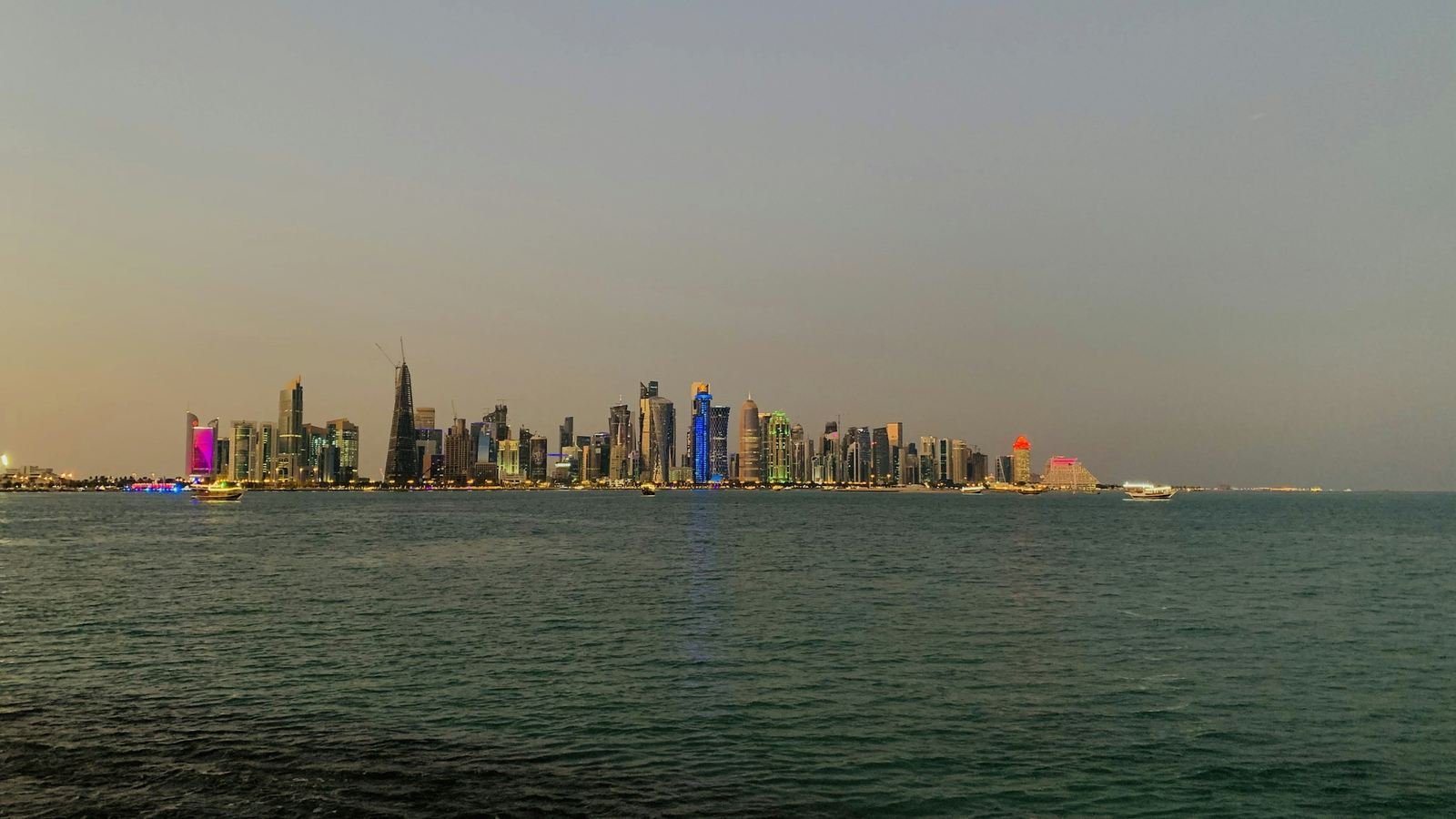
Doha is one of the safest capital cities in the world, and Qatar polices its public space with quiet thoroughness. Ask us what a bodyguard costs there and the answer starts with a correction of the premise: in Doha, as across the Gulf's showcase cities, you are not buying protection from the street. You are buying flawless movement, privacy around a recognisable name, and a single calm layer between your family and a city that fills to capacity every time a major event lands. That is the product — and it is what the pricing reflects.
The Short Answer
For a single, properly licensed close protection officer in Doha, a realistic 2026 figure is roughly $1,000 to $1,500 for a twelve-hour day, before vehicle and coordination — the upper international band, reflecting the small pool of genuinely qualified operators in-country. A fully coordinated protection day — officer, security-trained driver and vehicle, and the advance work that ties the movements together — starts from around €1,800 per day.
During marquee events — Formula 1 at Lusail, major football fixtures, the Doha Jewellery and Watches Exhibition, summit weeks — availability, not price, becomes the constraint. The best operators are contracted early, and late requests pay in compromise rather than money.
How Qatar Regulates Private Security
Private security in Qatar is a licensed activity under the country's private security services law (Law No. 19 of 2009 and its implementing decisions), supervised by the Ministry of Interior. Companies must hold an MoI licence, and personnel must be individually approved and carry valid identification. For the client, the practical test is simple: a legitimate provider evidences its licence and its officers' permits without being pressed.
Weapons are a near-absolute exception. Close protection in Qatar operates unarmed unless specific government authorisation exists, which for private clients it almost never does — and, frankly, almost never should. Doha's risk picture does not call for an armed posture, and the professional answer to the environment is planning, not hardware. Any provider leading its pitch with weapons is telling you it does not understand the country.
What Actually Moves the Number
The event calendar. Doha has built its modern identity on hosting: Grand Prix weekends, world-championship sport, ministerial summits, exhibition season. Each compresses tens of thousands of visitors into a city of manageable size, stretches hotel and transport capacity, and multiplies the planning required to move a principal cleanly. The same visit in a quiet week is simpler and cheaper.
The programme. A discreet stay at a Msheireb or West Bay hotel with two movements a day is the light end. A delegation schedule, a public appearance at an exhibition stand, or a family split between the city and a beach resort north of it multiplies movements — and movements are what protection is priced on.
Transport. Doha's distances are short but its peaks are sharp: event traffic around Lusail and the Corniche can triple journey times. A security-trained driver who knows the alternates — and the etiquette of hotel forecourts and VIP entrances — is half the plan, not an accessory. Doha's roads are also unforgiving of improvisation; route discipline matters more here than force of numbers.
Cultural fluency. Qatar is conservative, formal and deeply relationship-driven. Protection that works in Doha reads the room: majlis protocol, prayer times, Ramadan rhythms, the correct distance to keep around Qatari counterparts. An officer without that fluency creates friction that no amount of technical skill repairs.
Why the Cheapest Quote Costs More
Qatar has a sizeable guarding industry serving malls, compounds and construction — and a very small close protection profession. The cheap quote almost always draws from the first pool: a static guard in a suit, licensed for the wrong task, with no advance work and no plan beyond proximity. In a city where your actual exposures are privacy, media and movement, that is money spent on the wrong problem.
We quote transparently and itemise the scope in writing — officer hours, vehicle and driver, advance work, coordination — so you can read the quote line by line and see what each element buys.
A Realistic Budget
For a typical Doha visit — private terminal arrival, meetings in West Bay or Msheireb, dinners, perhaps a desert or Banana Island excursion — one licensed officer with a security-trained driver is the correct baseline, from around €1,800 per coordinated day. Event weeks justify booking well ahead; genuinely exposed programmes justify a second officer, scoped against the actual schedule rather than a default headcount.
If you are weighing the city itself, our related piece on whether Doha is safe for business travellers covers the risk picture in detail; for the wider region, see our guide to bodyguard costs in Dubai.
A Doha Day, Walked Through
Consider a representative programme. Arrival at Hamad International's premium terminal at 10:00 — the officer has been on the ground since 08:30, confirmed the vehicle, walked your hotel's arrival sequence and agreed a side entrance with the concierge. Meetings in West Bay through the early afternoon, a pause built around Asr prayer because your counterparts will observe it, a private viewing at a Msheireb gallery, then dinner at a restaurant whose private room was booked under a neutral name. Six movements, one visible member of staff, nothing to photograph.
Everything that made that day smooth happened before it started: the advance work, the timing discipline, the cultural calibration, the vehicle that was always already there. That gap — between presence and preparation — is exactly what separates the €1,800 coordinated day from the cheap quote, and it is the part the invoice can never quite show.
When to Book
Doha's professional close protection pool is among the smallest of the major Gulf capitals, which makes lead time the client's best tool. For a routine visit, two weeks' notice assembles a strong detail. For Grand Prix weekends at Lusail, major fixtures, the jewellery exhibition or summit weeks, work four to six weeks out — in those windows we are securing people before we are pricing them. Weapons authorisation, in the vanishingly rare cases it is even relevant in Qatar, is a state process with its own calendar and should never be assumed available for a commercial visit.
How We Work in Doha
Algoz coordinates close protection, secure transport and executive concierge across the Gulf as one discreet service, delivered through a vetted network of licensed local professionals. The officer in the lobby, the driver on the Corniche and the person confirming your majlis appointment work from a single plan — which is why the day looks effortless.
If you are planning time in Doha and want a clear, itemised picture of what protection costs to do properly, speak to us. We will scope it against your actual programme and tell you honestly where you need presence and where you do not.
Frequently Asked Questions
How much does a bodyguard cost per day in Doha?
For a single, properly licensed close protection officer in Doha, budget roughly $1,000–$1,500 for a 12-hour day, before vehicle and coordination. A fully coordinated protection day — officer, secure transport and operational planning — starts from around €1,800 per day.
Is hiring a bodyguard legal in Qatar?
Yes, when the service is delivered by a private security company licensed by Qatar's Ministry of Interior under the country's private security services law, with individually permitted personnel. Unlicensed freelance protection is not legal.
Are bodyguards in Doha armed?
As a rule, no. Close protection in Qatar operates unarmed unless specific government authorisation exists, which is exceptional. Effective protection in Doha is built on advance planning, secure mobility and coordination rather than visible force.
Do you actually need close protection in Doha?
Doha is one of the world's safest capitals, so protection there is rarely about crime. Clients use it for privacy, movement coordination during major events, media management and continuity with the security posture they maintain elsewhere.
Planning Time in Doha?
Algoz coordinates close protection, secure transport and executive concierge across the Gulf as one discreet service — scoped against your actual programme.
Request a Confidential Consultation